tox21-toxicity
| English | Português |
Predicting Chemical Toxicity from Molecular Structure (Tox21)
Can we tell whether a molecule is toxic just from its structure? This project builds and honestly evaluates machine-learning models that predict the results of 12 toxicity assays for about 7,800 chemicals. It also includes an app that profiles any molecule you paste in.
Data: Tox21 (US EPA, NIH, FDA) via MoleculeNet. It covers 7 nuclear-receptor assays (hormone disruption) and 5 stress-response assays (DNA damage, oxidative stress, mitochondrial damage). Each result is active or inactive. Classes are imbalanced (3–16% active) and some labels are missing.
Plain-language summary: open the live dashboard (source), a one-page overview for non-technical readers in English and Portuguese.
More projects: Why clinical trials stop early · Portuguese education data · Spotting students at risk in online courses
Key findings
-
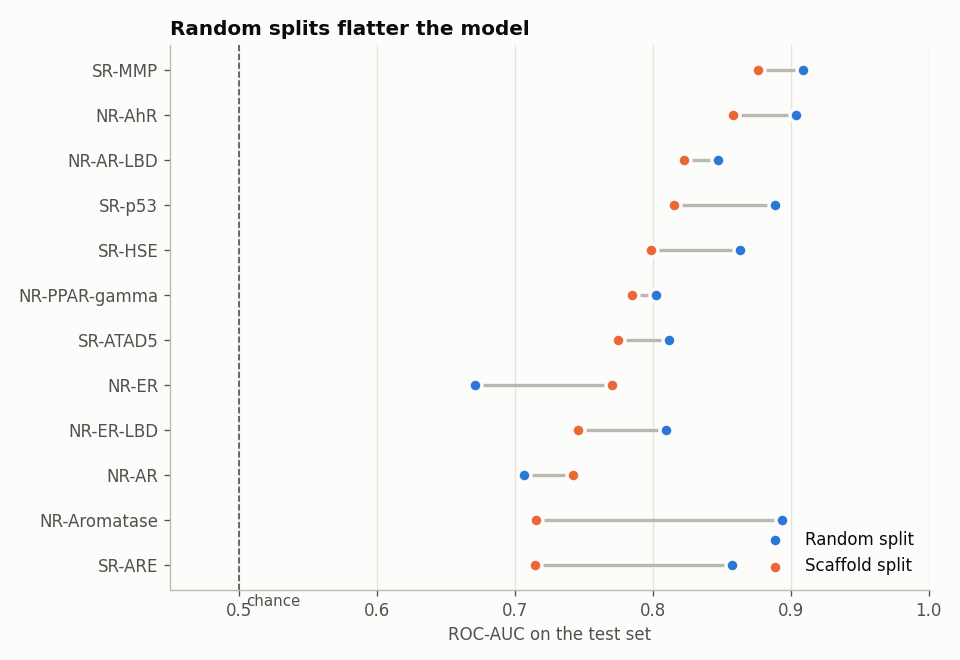
Random splits flatter the model. Under a scaffold split, where test molecules have ring systems never seen in training, mean ROC-AUC is 0.79, compared with 0.83 under a random split. The scaffold split is the honest estimate for new chemistry.
- Whole-molecule descriptors beat fingerprints (0.78 vs 0.72). Combining both with a random forest was best (0.79). Gradient boosting and logistic regression did worse.
-
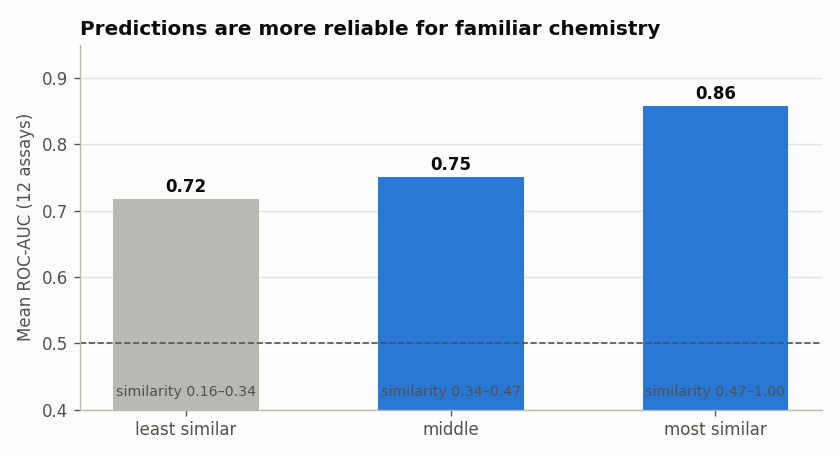
Trust depends on similarity. ROC-AUC is 0.86 for test molecules similar to the training data and 0.72 for the least familiar third, so every prediction should come with a similarity score.
- The model learns real chemistry.
- Activity at the “dioxin receptor” (AhR) rises from 1% to 33% with the number of aromatic rings.
- The top fragments for mitochondrial toxicity are lipophilic phenols such as pentachlorophenol, which are classic uncouplers.
- It is useful for prioritising compounds. Testing only the top 10% of compounds by model rank finds actives at 4x the random rate and recovers about 40% of all toxic compounds.
Toxicity profiler app
Paste a SMILES string, or pick an example such as bisphenol A, triclosan or benzo[a]pyrene. The app shows:
- the molecule;
- its predicted risk rank in each of the 12 assays;
- a reliability warning based on similarity to the training data;
- the nearest tested molecule, with its real lab results.
streamlit run app/app.py
Project structure
src/featurize.py        downloads Tox21; cleans molecules; computes Morgan fingerprints, RDKit descriptors, scaffolds and splits
src/train_models.py     trains the final per-assay random forests used by the app
src/style.py            shared chart style
notebooks/01_explore_tox21.ipynb      assays, imbalance, assay correlations, structure–activity patterns, scaffolds
notebooks/02_predict_toxicity.ipynb   random vs scaffold split, model comparison, applicability domain, toxic fragments, enrichment
app/app.py              Streamlit toxicity profiler
figures/                exported charts
toxicity-at-a-glance.html   plain-language dashboard
How to run
pip install -r requirements.txt
python src/featurize.py        # ~1 minute
python src/train_models.py     # a few minutes, only needed for the app
jupyter notebook notebooks/
Limitations
- High-throughput assay results are noisy, and “inactive” in a screen is not proof of safety.
- 2D features ignore 3D shape, which matters for receptor binding.
- Next steps: graph neural networks, multi-task learning across related assays, and conformal prediction for per-molecule confidence.
Educational project. The predictions are not a safety assessment.